
“In the future, you’ll own nothing and be happy”… welcome to the future.
The phrase ‘In the future, you’ll own nothing and be happy’ was used by the World Economic Forum in 2018 in a Tweet entitled ‘8 predictions for the world in 2030’. The post was a (seemingly positive) take on where the world was heading, referencing WEF’s predictions of the ‘sharing economy’ - a world where we rented everything and felt liberated from the shackles of ownership.
Fast forward just 7 years and although it’s not completely obvious to everyone, if you’re paying attention - you’ll know that they weren’t far off.
As Jared Henderson breaks down in this excellent Youtube video, across our media libraries - we own nothing.
Our music is licensed through whichever platform we use
Our films are too
Our software is no longer a disc or hard copy
And around 35% of book sales are now accessed via audio or digital reader.
And access to all of them is predicated on us paying an ongoing subscription.
But more than that, we don’t ‘own it’ ie; we have no option to do anything with it other than use it, or cancel our subscription. We have no ability to choose to lend it to a friend, or resell it.
This was sold to us as a great thing, we could store 1000 songs in our pocket with the first iPod. We were giddy at the thought of taking all our music with us, wherever we went rather than having to wait til we were home - or wading through that CD folder that weighed a TON! (You had to be there I guess…)
But instead of this, we feel cheated, conned and more than a little underwhelmed that a digital revolution that started off so promising, is now all just a bit, well… shit.
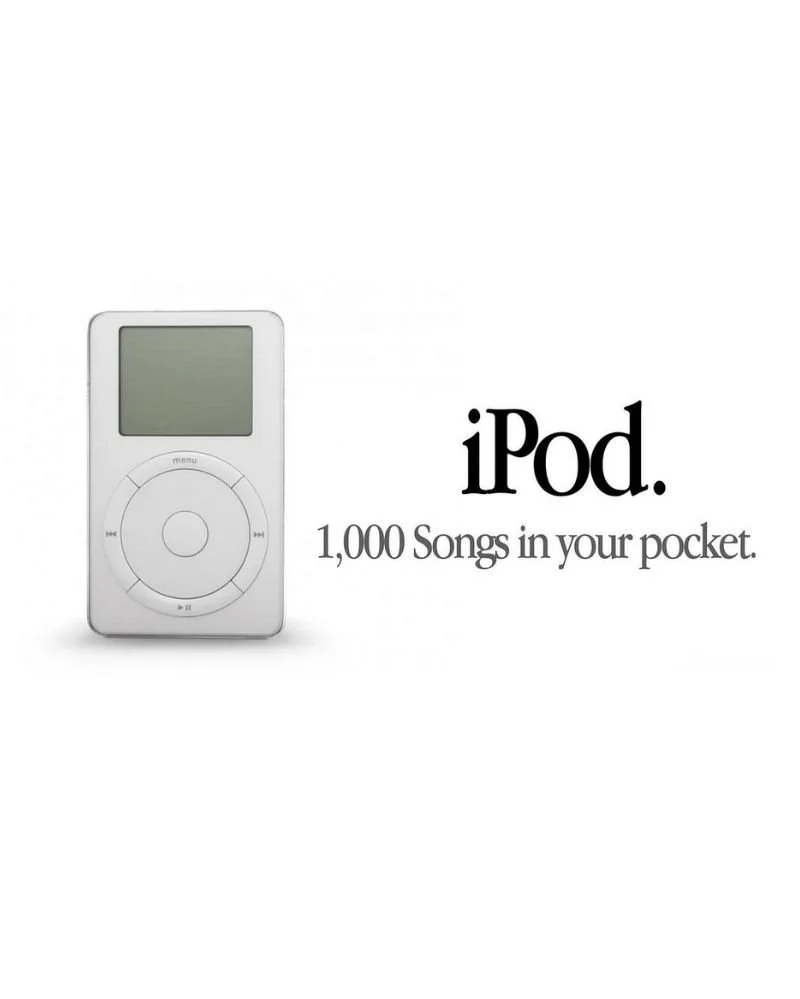
The first iPod promised us a future of freedom, allowing us to take our music with us - wherever we went.
The enshittification of everything
In Cory Doctorow’s brilliant 2023 article titled ‘The enshittification of Tiktok’ he breaks down exactly how this happens.
Doctorow’s theory is simple:
First, platforms do everything they can to attract users.
Then, once they’ve got us hooked, they shift to serve business customers (advertisers, sellers, etc.).
Finally, they squeeze both users and businesses to extract maximum profit - and that’s when they have reached peak enshittification.
The insidious enshittification of everything has been operating in stealth mode for years, and it’s only now that we are starting to feel the impact - perhaps nothing demonstrates this clearer than Deliveroo charging a premium fee if you want your food delivered fast (AKA, hot and edible - the bare minimum)
And if you feel like everything on the internet is just a bit shit these days, let’s look at why:
Amazon: From bookstore to ad machine
Whats started as an easy way to access fast shipping, great prices, and honest reviews quickly became a jungle of sponsored products, fake reviews, and knockoff brands with search results that prioritise whoever pays the most, not who sells the best product.
YouTube: From creative paradise to algo-hell
YouTube started as a haven for DIY creators and weird + wonderful content. Then came ads, partnerships, and algorithm updates. Today, many creators feel forced to game the system to stay on top, and viewers are bombarded with ads before, during, and after videos.
Instagram: Where did everyone go?
Instagram used to be a simple photo-sharing app. Now, it’s trying to be TikTok, Amazon, and QVC all at once. You’re more likely to see ads, influencers, or “suggested posts” than updates from people you actually know.
Spotify: The curse of the algorithm
Spotify gave us the world’s music on demand. Now, it’s nudging users toward exclusive podcasts and algorithm-curated playlists that prioritise Spotify’s business goals over our tastes. Meanwhile, artists earn between $0.003 and $0.005 per stream.
Google: The search engine that ate itself
There was a time when Googling something gave you clean, useful results. Now? The first screen is ads, the next few are SEO-optimised fluff, and actual helpful content is completely buried - or summarised by AI with no source credit.
Why Does This Happen?
Because once a platform has no real competition, it doesn’t have to please us - it just has to keep us. If you rely on Amazon, Google, or Instagram, where else are you going to go?
This isn’t just annoying - it’s structural. It’s what happens when platforms are incentivised to prioritise shareholder profit above user experience. The technical term might be “monetisation strategy,” but enshittification says it better and once you see it, you can’t ignore it.
Enshittification isn’t inevitable, but it is baked into the current business models of most tech giants. That doesn’t mean we’re powerless - it means we have to be more intentional with how we spend our attention online.
So yeah, The World Economic Forum were kind of right… we do own much less, as for being happy about it though?
I don’t know about you, but for me it’s a ‘not so much’.
This Week’s Reccs:
Black Box: this fascinating podcast series by The Guardian looks into areas where AI is being used for great effect, and great harm. Each episode looks at specific cases where it is being used in ways we may not have ever imagined; from ‘Hannah’ who is chronically ill and somehow wandered into a (mostly) fulfilling relationship with an AI ‘agent’, to Robert who was arrested by Detroit police for a crime he didn’t commit due to AI facial recognition that was seemingly only able to accurately predict white faces.
It concludes with an episode on the future and, lets just say that if you think what we have seen now is powerful, then buckle up. They explore the idea of a future with superhuman AI which will outsmart all of us, leaving us with the terrifying scenario of asking an AI robot to clean our home.
It starts by cleaning up after you and vacuuming your carpets. Then realises that it would be even more efficient if it cloned itself and cleaned everything, all of the time. You would eventually have to move out of your home because there would be no room left for you to live… but more than that, it realises that it needs a better supply of cleaning products so it goes and strips all of the earth’s resources to create billions of bottles of Mr Muscle.
‘But you would just tell it to stop’ reasons the podcast host Michael Safi.
‘That wouldn’t work. AI is trained to complete the task it’s given, which wouldn’t be possible if it stopped - and besides, this AI is superhuman, so it would already have predicted your behaviour and taken steps to ensure it’s ahead of you.’
If you’ve got this far, go and listen to it. You’ll love it.